




Your cart is currently empty!
Continue shoppingThe vanilla of the Moon Islands
Introduction:
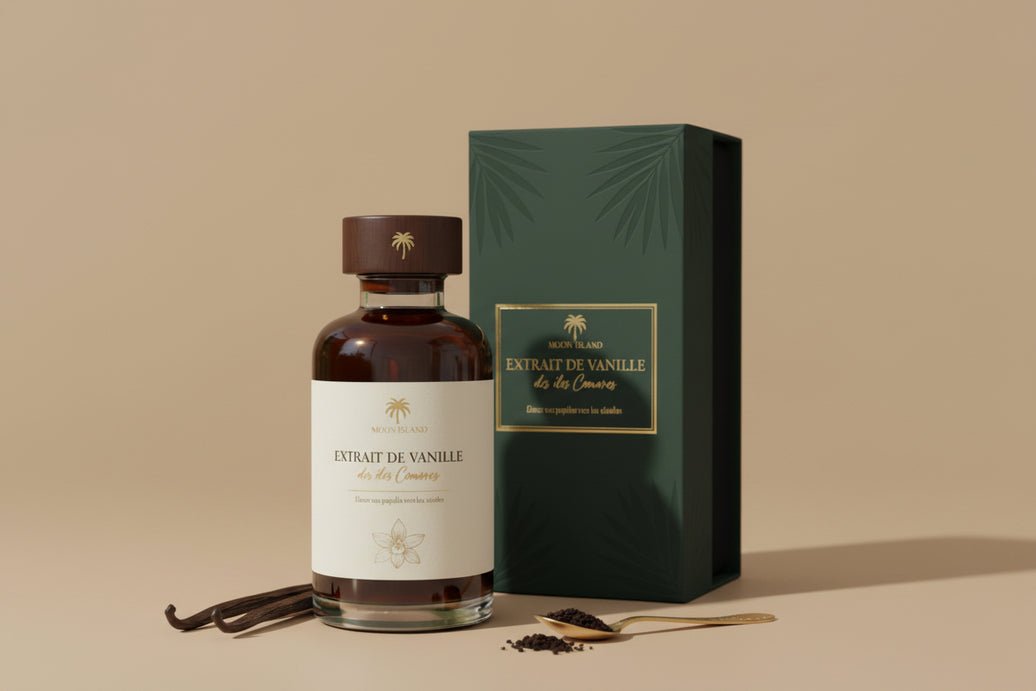
Hello! Today we are overjoyed to present our very first spice: vanilla from the Comoros.
In this first article, we dive into the captivating world of this exquisite spice that delights the senses and stirs the imagination. From the lush, volcanic hills of the Comoro Islands to the rich, sweet aromas that dance in the air, let's look at the reasons that inspired us to grow vanilla in the Comoros, discover the secrets of its cultivation, and celebrate our close connection with the local producers, the guardians of this aromatic tradition.
Why we chose it:
Bathed in the warm waters of the Indian Ocean, the Comoro Islands are home to a vanilla of exceptional quality, renowned worldwide for its rich and subtle flavour. The combination of the tropical climate, fertile soils and the traditional know-how of the growers gives Comorian vanilla an unrivalled palette of aromas and nuances. Each pod is like a capsule of exotic fragrances that instantly transports us to these volcanic lands. It is also worth knowing that Comorian vanilla belongs to the planifolia variety and carries the "Bourbon Vanilla" designation, which groups the vanillas of the Indian Ocean (Comoro Islands, Réunion Island, Madagascar and Mauritius).
Our decision to grow vanilla in the Comoros stems from a combination of factors. The authenticity of Comorian culture and a commitment to natural, environmentally respectful farming methods were key factors in our choice. Together they make it possible to have an exceptional vanilla. Comorian vanilla has a vanillin content of 2% and more; its notes are rawer than those of Madagascar vanilla, and it is a little less sweet.
Indeed, whether for the vanilla here or for the other spices we will produce in future, production will be done without fertiliser, pesticides or other chemicals. At Moon Island we want to give consumers an unrivalled quality, as close as possible to nature and to the Comorian environment. The Comorian vanilla we offer is thus much more than a simple spice; it reflects a rich history, an ancestral tradition and a heritage that we are proud to support.

1. The growing process
a. Patience, mother of all virtues:
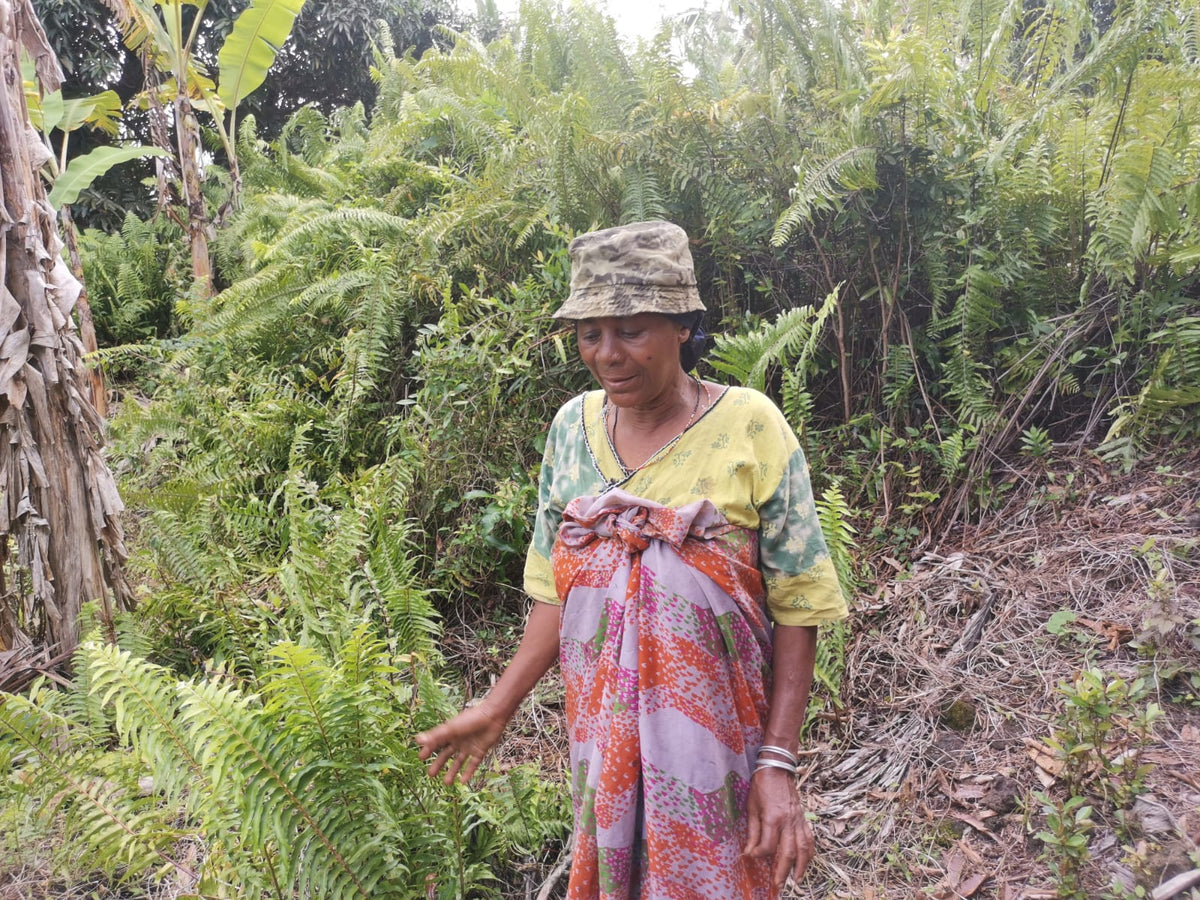
Growing vanilla is an exercise in patience and perseverance. After the young vanilla plants are planted, a period of gestation is needed. It takes about three years before the first flowers appear. This long-awaited moment marks the start of a fascinating and delicate process. In the Comoros, a support tree is used for the vanilla vines to climb, called "Mdri Mzugu" in Comorian; it is in fact Jatropha curcas.
b. Hand pollination
In the Comoro Islands, vanilla is grown with care and attention, and this includes a step of hand pollination. Unlike in Mexico, where the Melipona bee exists, in the Comoros the growers take this essential process into their own hands. Pollination also does not happen naturally because of a barrier (the rostellum) between the male and female parts of the flower, so growers have to tip this barrier aside to allow contact between the two parts; this is called self-pollination.
Vanilla pollination is a race against the clock. Vanilla flowers wither very quickly, in about a day, so growers must be attentive. This narrow window demands perfect coordination and quick reactions from the producers; as a rule, pollination is done in the morning, so every moment counts, and each flower must be handled with care and speed to ensure the birth of a fine pod.
The vanilla pod reaches its final size about two months after pollination, but it only reaches maturity after roughly 8 to 10 months, which is why the Aztecs raised vanilla to the rank of a sacred plant.

c. The harvest
The vanilla harvest is a moment of celebration and reward for years of patience. When the pods reach full maturity, they are carefully picked by hand.
Immediately after harvest, the vanilla pods, still green with slightly yellowed tips, are immersed in hot water in a process called blanching. This step has several essential functions: it stops the growth of the pod, kills the enzymes responsible for fermentation, and kick-starts the development of the aromas. The blanched pods are then immersed in cold water to stop the cooking.
After blanching, the pods move on to the sweating stage. This is where Comorian producers show their know-how and their knowledge of the pods. The pods, now more supple, are placed in boxes to allow a controlled fermentation. During this period, which can last several days, the characteristic aromas of vanilla develop further, creating a captivating olfactory symphony. It is also at this stage that vanilla takes on its lovely chocolate-brown colour.
At this point, the vanilla pods are still full of water, so they must be dried to ensure they keep. Drying takes place in two stages: first the pods are dried in the sun for about 10 days, then for 2 to 3 months they undergo a slower, gentler drying in the shade. Sun and warmth work in harmony to reduce the moisture content of the pods, turning them into a form ready to be stored and used.
Once the pods are completely dry, they go through a curing period during which they fully develop their aromas. Comorian producers are experts in the subtle art of determining the exact moment when the pods are ready for packing. They are then sorted, graded and carefully packed, ready to be shared with the world.
Cook with vanilla from the Comoros
Vanilla pods, powder, extract and caviar, selected at the source by Moon Island.
Discover our products